
Multiplying Positive and Negative Numbers: A Guide to Mastering the Basics
.gif)


Understanding the Rules of Multiplication
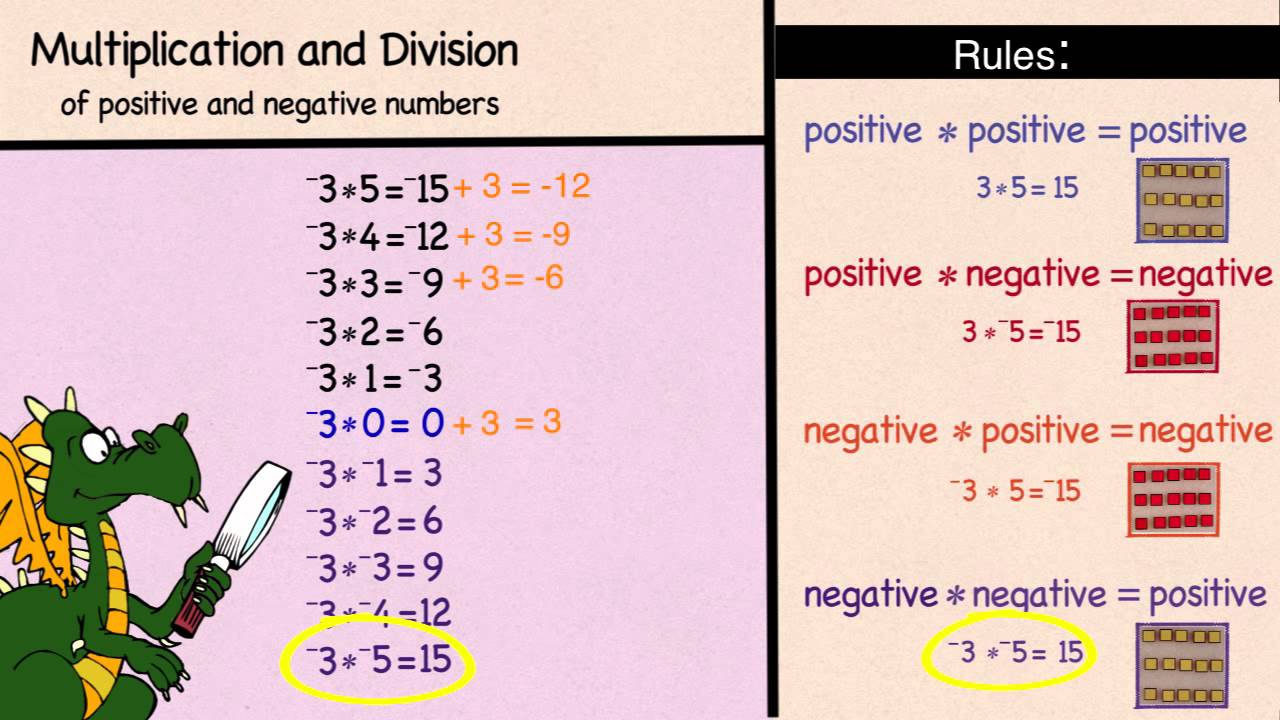
Multiplying positive and negative numbers is a fundamental concept in mathematics that can seem daunting at first, but with practice and patience, it can become second nature. When multiplying two numbers, it's essential to consider their signs, as this determines the outcome of the operation. A positive number multiplied by another positive number results in a positive product, while a negative number multiplied by a negative number also yields a positive product.
The rules of multiplication state that when you multiply two numbers with the same sign, the result is always positive. On the other hand, when you multiply two numbers with different signs, the result is always negative. For instance, 2 * 3 = 6 (positive * positive = positive), and -2 * -3 = 6 (negative * negative = positive). However, -2 * 3 = -6 (negative * positive = negative), and 2 * -3 = -6 (positive * negative = negative).
Applying the Rules to Real-World Examples
To further illustrate the concept, let's consider some examples. If you have -4 * 5, the result would be -20, as the negative sign takes precedence. Similarly, -4 * -5 would result in 20, as the two negative signs cancel each other out. It's crucial to remember that the order of the numbers does not affect the result, so -4 * 5 is equal to 5 * -4.
In real-world applications, multiplying positive and negative numbers is used in various fields, such as science, engineering, and finance. For instance, in physics, you may need to calculate the force of an object moving in a negative direction, which would involve multiplying a negative number by a positive number. By mastering the rules of multiplication, you'll become more confident in your ability to tackle complex math problems and apply them to real-world scenarios.